Starting yoga at home can feel confusing. You might wonder if you need special equipment, if you are flexible enough, or if you are doing the poses correctly. The good news is that you do not need any of those things to begin. You only need a small space, a little time, and the willingness to move slowly.
This guide walks you through easy yoga exercises that work well for beginners. Each pose is explained in plain language. You will learn how to do it, why it helps, and how to make it easier if your body needs something different. By the end, you will have a short routine you can do today without feeling lost or overwhelmed.
Why Yoga at Home Works for Beginners?
Practicing at home gives you a private space to learn at your own speed. There is no pressure to keep up with a class or to look a certain way. You can pause, rest, or repeat a pose as many times as you want. This freedom is especially helpful when you are just starting because your body is learning new movements.
Yoga is not just about stretching. It also asks you to pay attention to your breath and to how your body feels. When you practice at home, you can focus on those things without distractions. You can also choose a time that fits your day, whether that is a quiet morning moment or a few minutes before bed.
Setting Up Your Space
You do not need a lot of room. A clear spot on the floor that is about the size of a yoga mat is enough. If you do not have a mat, a carpeted floor or a folded blanket works fine. The surface should be firm enough to support you but soft enough to be comfortable on your knees and easy yoga exercises for beginners at home.
Try to find a place that is quiet and free of clutter. A simple wall or a window to look at can give your eyes a place to rest while you hold a pose. Keep a chair nearby if you think you might want extra support for balance. Wear clothes that you can move in easily, nothing too tight or restrictive.
Read Also: What To Expect In Your First Yoga Class
Breath First: The Foundation of Every Pose
Before you move into any pose, take a moment to notice your breath. Sit or lie down in a comfortable position. Breathe in through your nose and let your belly expand. Breathe out through your nose and let your belly relax. Do this for five slow breaths.
This simple act of breathing deeply tells your body that it is time to slow down. It also gives you something to focus on besides the busy thoughts in your head. Throughout your practice, keep coming back to your breath. If you notice you are holding your breath during a pose, that is a sign to soften or come out of the pose for a moment.
Easy Yoga Exercises You Can Do at Home
The poses below are gentle and basic. They work on different parts of the body, and together they create a short sequence you can follow. Do them in the order listed, or pick a few that feel right for you on any given day.
Cat-Cow Stretch
Start on your hands and knees. Place your wrists under your shoulders and your knees under your hips. Your back should be flat, like a table.
As you breathe in, let your belly drop toward the floor and lift your chest and gaze slightly upward. This is the Cow part. As you breathe out, round your back toward the ceiling, tuck your chin, and draw your belly in. This is the Cat part.
Move slowly between these two shapes, matching the movement to your breath. Repeat five to ten times. This stretch warms up your spine and helps release tension in your back, especially if you sit for long periods . If your wrists feel uncomfortable, you can make gentle fists and rest on them instead of flat palms, or place a folded towel under your hands.
Downward-Facing Dog
From hands and knees, tuck your toes under and lift your hips up and back. Your body will make an upside-down V shape. Your knees can stay bent, especially at first. The most important thing is that your spine feels long, not that your heels touch the floor.
Press your hands firmly into the mat and let your head hang between your arms. Stay here for a few breaths. Downward Dog stretches the back of your legs and your shoulders while also building strength in your arms . If your wrists need a break, you can lower your forearms to the floor instead of your hands.
Child’s Pose
From hands and knees, bring your big toes together and spread your knees apart. Push your hips back toward your heels and walk your hands forward. Let your chest and forehead rest on the mat or on a cushion. Your arms can be stretched out in front of you or resting by your sides.
Breathe deeply here. Child’s Pose is a resting pose. It gently stretches your lower back and hips and gives you a moment to pause . If your knees feel pressure, place a folded blanket or pillow behind your knees or between your calves and thighs.
Bridge Pose
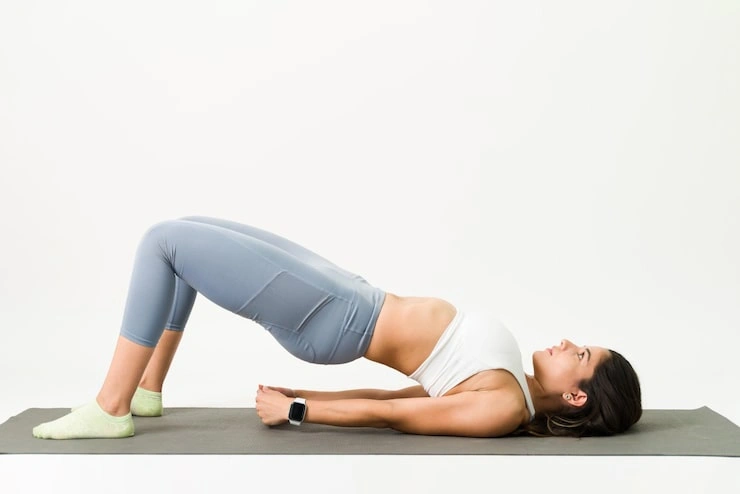
Lie on your back with your knees bent and your feet flat on the floor, about hip-width apart. Rest your arms by your sides with your palms facing down.
Press your feet into the floor and lift your hips up. Keep your knees pointing forward, not falling out to the sides. You can clasp your hands under your back if that feels comfortable. Hold for a few breaths, then lower your hips slowly. Bridge Pose strengthens your glutes and lower back while opening your chest . If lifting your hips feels like too much, lift only a little bit at first.
Seated Twist
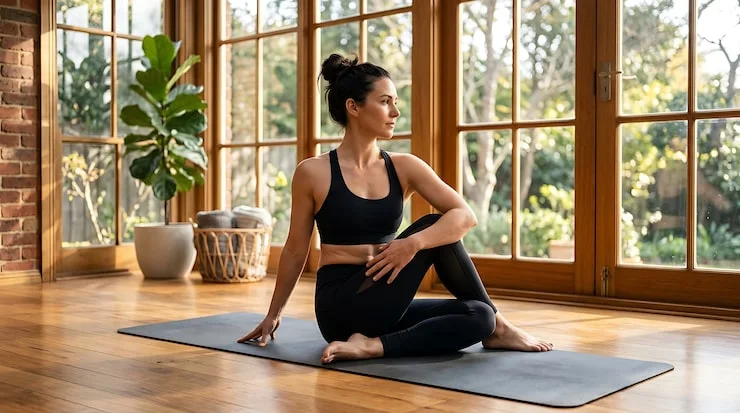
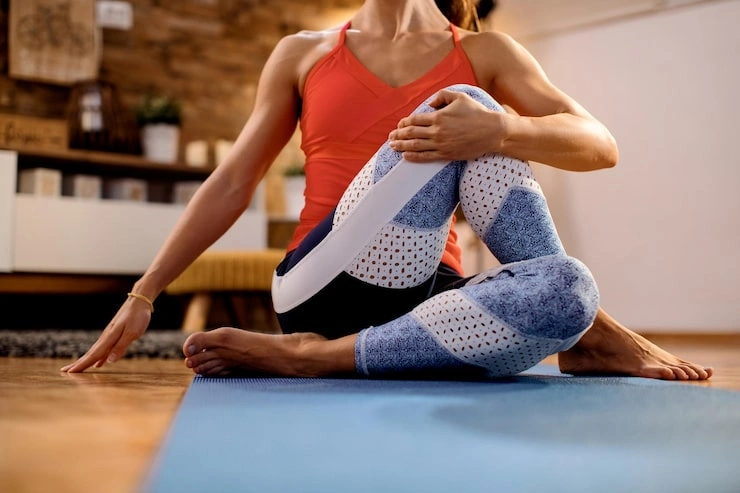
Sit on the floor with your legs crossed. Sit up tall. Place your right hand on your left knee and your left hand on the floor behind you. As you breathe out, gently turn your chest and gaze toward the left. Keep your spine long rather than collapsing forward. Hold for a few breaths, then come back to center and repeat on the other side.
This twist helps loosen your spine and can ease tension in your lower back. Move slowly and do not force the twist. The goal is a gentle stretch, not the deepest possible turn.
You May Also Like: Yoga Poses For Neck Pain: Simple Yoga Stretches to Ease Neck Pain
Legs Up the Wall
Find a clear spot next to a wall. Sit with one side of your body close to the wall. Then swing your legs up the wall as you lie back on the floor. Your hips can be a little away from the wall or close to it, whatever feels comfortable. Rest your arms by your sides.
Stay here for several minutes if you have time. This pose is restful and helps calm your body. It can also relieve tired legs . If your lower back feels uncomfortable, slide a folded blanket under your hips for support.
A Simple Routine to Follow
You do not have to do every pose every day. A short practice that you actually do is far better than a long practice you keep putting off. Here is a simple sequence that takes about ten minutes:
Start with five slow breaths sitting or lying down. Move into Cat-Cow for five rounds. Then come into Downward Dog for three breaths. Rest in Child’s Pose for five breaths. Roll onto your back for Bridge Pose, holding for three breaths and repeating twice. Sit up for a gentle twist on each side. Finish by lying on your back with your legs up the wall for a few minutes.
That is a complete practice. Some days you might only have time for Cat-Cow and Child’s Pose. That is enough. The point is to show up and move in a way that feels kind to your easy yoga exercises for beginners at home.
Common Beginner Worries
Many people worry that they are not flexible enough for yoga. Flexibility is not a requirement. It is something that grows with practice. When you start, bend your knees as much as you need. Use a chair for balance if you feel unsteady. Place a pillow under your knees if they feel sensitive.
Another common worry is doing a pose “wrong.” In yoga at home, the best guide is your own body. If a pose feels sharp or painful, come out of it. If it feels like a gentle stretch, you are likely in a good place. There is no perfect shape to achieve. There is only the shape that works for you today.
Final Thoughts
Easy yoga exercises at home are within reach for almost anyone. You do not need a fancy studio or a perfect body. You need a small space, a few minutes, and the willingness to breathe and move slowly. Start with the poses that feel good to you. Come back to them often. Over time, your body will feel more open, your mind will feel calmer, and your home practice will become a part of your day that you look forward to.