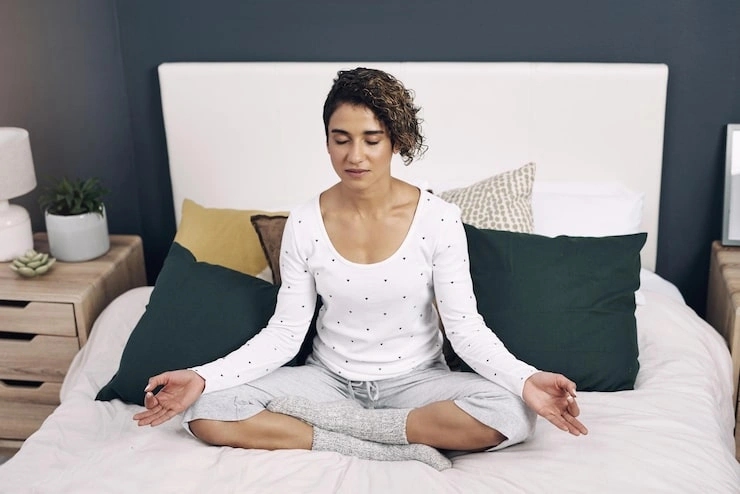
If you are lying awake at night with a mind that will not slow down, you are not alone. Many people struggle to fall asleep because their thoughts keep racing long after they turn off the lights. Meditation before bed offers a simple, free way to quiet your mind and help your body transition into rest.
This guide explains exactly how to start a bedtime meditation practice. You do not need experience, special equipment, or a lot of time. You just need a few minutes and meditation before bed for beginners.
Why Your Brain Fights Sleep (And How Meditation Helps)
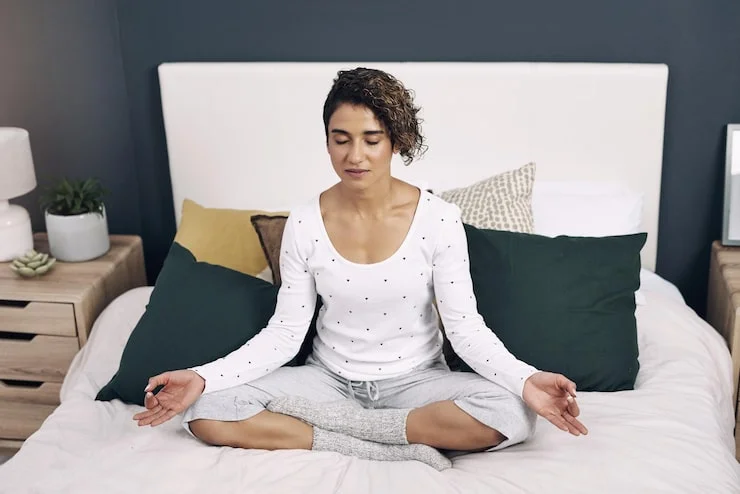
When you lie down at night, your body may be tired, but your mind often has other plans. It replays conversations, worries about tomorrow, or creates mental lists of things you forgot to do. This mental chatter activates your body’s stress response, keeping you alert when you should be winding down.
Meditation works by interrupting this cycle. It gives your mind one simple thing to focus on, such as your breath or the feeling of your body against the bed. When your attention settles on that single point, the mental noise fades into the background. Your breathing slows. Your heart rate drops. Your body shifts from a state of alertness into a state of rest.
Research supports this. A 2019 review of studies found that mindfulness meditation may improve sleep quality and reduce symptoms of insomnia. The National Center for Complementary and Integrative Health notes that mindfulness meditation practices may reduce insomnia and improve sleep quality, with effects comparable to cognitive behavioral therapy or exercise. A smaller study focused specifically on chronic insomnia found that participants who practiced meditation showed significant reductions in total wake time and pre-sleep arousal compared to those who only tracked their sleep.
The key is consistency. Meditation is a skill, like any other. It may take a few nights before you notice a difference. But once your brain learns to associate the practice with bedtime, falling asleep can become easier over time.
Read Also: Meditation For Anxiety Before Bedtime
How to Start: A Simple Bedtime Meditation for Beginners?
You do not need to sit cross-legged on the floor or chant anything. You can do this lying in bed, under your covers, with the lights off.
Step 1: Get comfortable.
Lie on your back or your side, whichever feels natural. You can put a pillow under your knees if that helps your lower back relax. Close your eyes. You do not need to hold your body in any special way. Just let yourself sink into the mattress.
Step 2: Take a few slow breaths.
Breathe in through your nose. Breathe out through your mouth. Make your exhale longer than your inhale. For example, breathe in for a count of four, and breathe out for a count of six. Do this five times. The long exhale is important because it signals to your nervous system that you are safe and can relax.
Step 3: Focus on one thing.
Pick something simple to pay attention to. You can focus on the feeling of air moving in and out of your nostrils. You can focus on your belly rising and falling. You can focus on a word or phrase, such as “peace” or “let go,” and repeat it silently with each exhale.
Step 4: When your mind wanders, bring it back.
This is the most important part. Your mind will wander. It is supposed to. You might start thinking about what you need to do tomorrow, or replay a conversation from earlier. When you notice this happening, do not get frustrated. Simply notice that your thoughts have drifted, and gently bring your attention back to your breath or your word. You might have to do this dozens of times. That is normal. Each time you bring your attention back, you are strengthening your ability to let go.
Step 5: Let go of trying to fall asleep.
This sounds strange, but it matters. If you meditate with the goal of forcing yourself to sleep, your brain will stay active and tense. Instead, focus on the meditation itself. Think of it as giving your mind a rest, not as a task you must complete. Sleep will often come on its own when you stop chasing it.
Meditation Techniques You Can Try Tonight

There are several styles of meditation that work well for beginners at bedtime. You can try one, or rotate between them until you find what feels right for you.
Body scan meditation.
This practice involves moving your attention slowly through your body, from your toes to your head. As you focus on each part, you notice any tension you are holding and consciously let it go. For example, you might notice that your jaw is clenched or your shoulders are raised. When you find tension, imagine it melting away with your next exhale. A body scan helps you become aware of physical stress you did not realize you were carrying, and it gives your mind a structured task to follow instead of spiraling into worry.
Breathing meditation.
This is the simplest form. You place all your attention on the sensation of your breath. You feel the cool air entering your nose and the warm air leaving your mouth. You notice the pause between breaths. When thoughts arise, you let them pass without engaging with them, and you return to the breath. The 4-7-8 technique is a specific pattern many people find helpful: breathe in for four seconds, hold for seven seconds, and exhale slowly for eight seconds. Repeat this cycle four times.
Guided visualization.
In this practice, you imagine yourself in a peaceful place. It could be a beach, a forest, a quiet room, or anywhere that feels safe and calm. You picture the details: what you see, what you hear, what the air feels like on your skin. Guided meditations are available as audio tracks, which can be especially helpful for beginners because you simply listen and follow along. The voice gives your mind something to hold onto so it does not drift into anxious territory.
Progressive muscle relaxation.
This technique involves tensing and then relaxing each muscle group in your body. You start with your toes, squeeze them for a few seconds, and then release. You move up to your calves, your thighs, your stomach, your shoulders, and finally your face. The contrast between tension and relaxation helps you recognize what it feels like to be truly relaxed, and it releases physical stress that has built up during the day.
Gratitude reflection.
Before you settle into your breathing practice, you can spend a minute or two thinking of things you are grateful for from your day. They can be small: a good meal, a kind word from a friend, the warmth of your bed. This shifts your mind away from worry and toward a more positive frame of mind, which can make it easier to relax.
You May Also Like: Meditation Routine Before Bedtime For Adults
FAQs
How long should I meditate before bed?
Start with five minutes. That is enough to begin building the habit. As you get more comfortable, you can extend to ten or fifteen minutes. The length matters less than the consistency. Five minutes every night is better than thirty minutes once a week.
What if I cannot stop my thoughts?
You cannot stop your thoughts, and you do not need to. The goal of meditation is not to empty your mind. The goal is to notice when your mind has wandered and to bring your attention back. Each time you do this, you are practicing the skill of letting go. It is like doing a repetition at the gym. The wandering is not a failure; it is part of the practice.
What if meditation makes me more anxious?
For some people, sitting quietly with their thoughts can feel uncomfortable at first. If this happens, try a guided meditation instead of silent practice. Having a voice to follow gives your mind somewhere to rest. You can also try a body scan or progressive muscle relaxation, which give you physical sensations to focus on rather than just your thoughts. If meditation consistently makes you feel worse, it is worth talking to a healthcare provider about other approaches.
Can I meditate in bed?
Yes. For bedtime meditation, lying in bed is perfectly fine. Some meditation teachers suggest sitting up to avoid falling asleep, but the goal here is to fall asleep. So lying down is not only acceptable, it is ideal.
Do I need an app or a video?
No. You can meditate on your own with just your breath. However, guided meditations can be helpful for beginners because they provide structure and keep your mind from wandering too far. If you use an app or video, dim your screen or turn it off entirely and just listen to the audio. Bright screens can interfere with sleep.
Tips to Make Bedtime Meditation Easier
Keep it simple. You do not need a complicated routine. Pick one technique and stick with it for a week before trying something else. Consistency builds the habit faster than variety.
Dim the lights. Bright light signals to your brain that it is time to be awake. Turn off overhead lights and use a small lamp or just the light from your phone if you need guidance. Better yet, turn the screen off and listen.
Do not check the time. Looking at the clock when you are trying to sleep creates pressure and anxiety. Turn your phone face down or leave it in another room.
Pair it with something you already do. Attach your meditation to an existing bedtime habit. For example, after you brush your teeth, you meditate for five minutes. This makes it easier to remember and turns it into a natural part of your routine.
Be patient with yourself. Meditation is a skill. Your first few nights might feel awkward or pointless. That is normal. The benefits build over time. Give yourself permission to be a beginner.
When to See a Doctor?
Meditation is a helpful tool for many people, but it is not a cure for every sleep problem. If you have tried meditation and other healthy sleep habits for several weeks and still struggle to sleep, it may be time to talk to a healthcare provider. Conditions like sleep apnea, restless leg syndrome, and chronic insomnia may require medical treatment. A doctor can help you figure out what is going on and what options are available.
Meditation before bed is one of the simplest things you can do to improve your sleep. It costs nothing, takes only a few minutes, and you can start tonight. Lie down, close your eyes, and take one slow breath. That is all it takes to meditation before bed for beginners.